
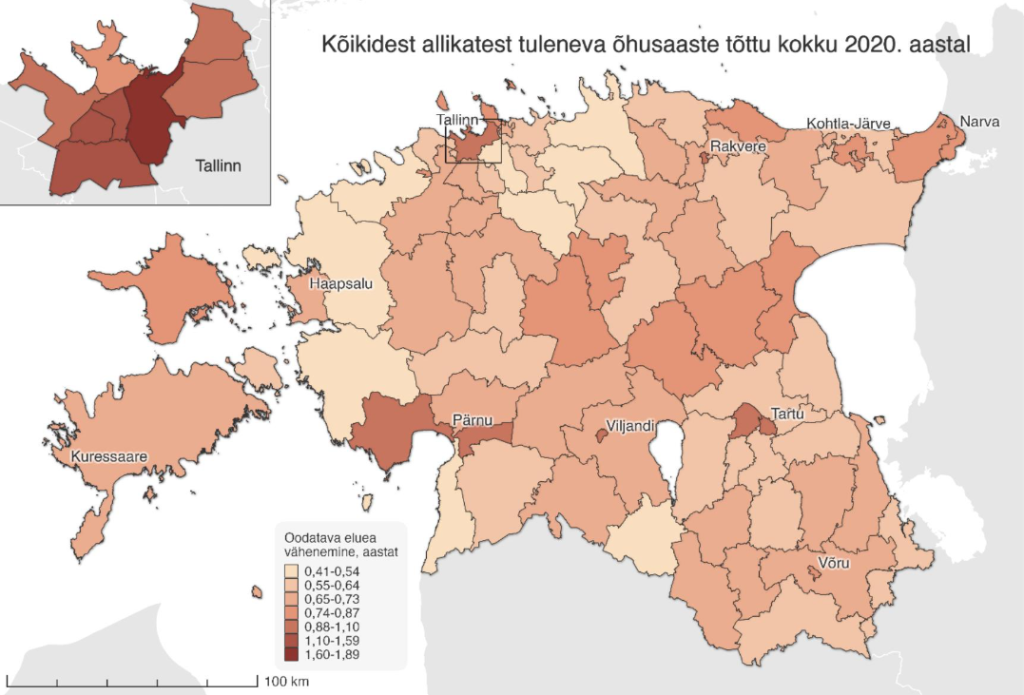
According to Hans Orru, the head of the study and professor of environmental health at the University of Tartu, air pollution has a significant effect on human health. This was evidenced in 2020 by 1,179 early deaths, 14,179 lost years of life and a reduction in life expectancy by nearly 10 months. ‘All this also has a very substantial socio-economic external cost, i.e. the monetary equivalent of the health impact is 666 million euros per year.’
More specifically, the study examined the impact of various sources of air pollution. Traffic and local heating had the largest negative impact. The greatest damage caused by traffic was in Tallinn, especially in the city centre where life expectancy is decreased due to traffic pollution by more than a year. According to Orru, the sources of traffic pollution are both exhaust gases and road dust. ‘A lot of road dust is created in cities by studded tyres, which release fine particles into the air as they wear down roads and are worn down themselves.’
As a positive example, Orru pointed out that air quality has significantly improved over the last decade, which has reduced health impacts by nearly 30 per cent. ‘The improvement in air quality stems from the implementation of less polluting cars, but the number of cars is still constantly increasing. Although electric cars do not discharge exhaust gases, they still produce road dust.’
Emissions caused by local heating can be reduced by the use of dry wood, better heating techniques and heating appliances as well as more widespread connection to district heating in densely populated areas.
Orru believes that the negative health impacts of air pollution can be somewhat offset by greenery. ‘Green areas located within a radius of around 500 metres from your residence are especially important, as this makes them easily accessible.’
According to Mikk Toim, adviser to the Ambient Air and Radiation Department of the Ministry of the Environment, the state is working hard to reduce air pollution, creating opportunities for the implementation of less polluting sources of emission as well as improving air monitoring and people’s awareness of the effects of air pollution. ‘The less air pollution, the better the health of not only people, but ecosystems in general. Such studies show what air pollution does to us – how it shortens life expectancy and increases financial costs,’ claimed Toim, adding that the completion of the study coincided with the recent proposal of the European Commission to amend air quality directives. ‘The most important part of the proposal is reducing the limit values of pollutants to levels close to the recommendations of the World Health Organisation. This would also reduce the health impacts of air pollution,’ Toim concluded.
The results of the study were presented on 30 November and the study is available on the website of the Ministry of the Environment at https://www.envir.ee/keskkonnakasutus/valisohk/uuringud-ja-aruanded.

