
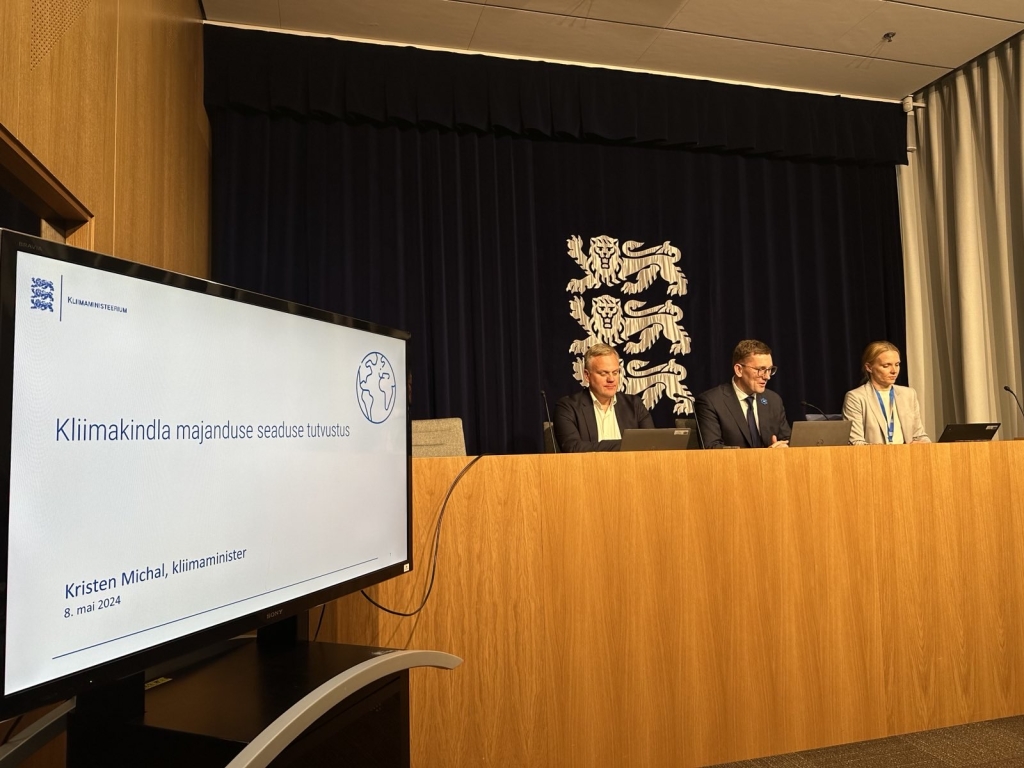
“The transition to renewable energy creates space for the development of new industries in Estonia. Clean and more affordable energy reduces emissions, increases the competitiveness of the economy and export capacity, and creates space for bringing new industries to Estonia. This is the way that the Climate Resilient Economy Act will contribute to our wealth and economic growth. Reduction of pollution, transition to new technologies and establishment of clear rules will in turn ensure a very important thing in Estonia – protection of our clean and well-preserved nature,” explained Minister of Climate Kristen Michal.
“There is a lot of uncertainty in the economic and legal environment, and the new law will help counterbalance that by creating the necessary legal certainty and providing predictability. The state will support the development of new technologies, and we will give them preference in public procurements. We will facilitate innovation and testing of new technologies. We will create opportunities for the higher valorisation of local resources. All these directions will increase our wealth by keeping nature clean, reusing materials, and valuing each unit higher,” explained the minister of climate the impact that the law will have on the economy.
The law will also provide for adequate protection of Estonian nature. “We will agree on a wise use of resources and a balanced economic policy. We will channel money into nature-friendly technologies. We will adopt technologies that reduce the burden on nature. We will better prepare ourselves for coping with climate change because no matter how hard we try, changes are already a reality,” explained the minister.
As a result of all this, we will ensure a better living environment and livelihood for the people. “We will preserve natural diversity, which in turn means a healthier and better life for everyone. A higher value-added economy allows to increase incomes and expand choices. Practical things, such as public transport options, will also improve, urban space will be better planned, technologies will be updated and there will be less pollution,” said the minister.
The law will set national and sector-based targets for reducing greenhouse gas emissions.
Nationwide targets for reduction of emissions (compared to 1990):
- the goal for 2030 is to reduce emissions by 55%
- the goal for 2035 is to reduce emissions by 71%
- the goal for 2040 is to reduce emissions by 82%
By 2050 we plan to achieve climate neutrality.
Transition to renewable electricity will have the biggest impact on reduction of emissions. “Since the transition to renewable energy significantly reduces greenhouse gas emissions, by 2030 emissions can decrease even by up to 66%. This brings us significantly closer to the goal of climate neutrality, which is very important for slowing down climate change and thus preventing natural, economic and health damage,” explained Kristi Klaas, the undersecretary for green transition.
The sectoral targets for the reduction of emissions are set in comparison with 2022. The sectoral targets for reduction of emissions are as follows:
|
|
2030 |
2035 |
2040 |
|
Energy |
-37% |
-45% |
-84% |
|
Oil shale industry |
+40% |
+12% |
-16% |
|
Other processing industries and construction |
+116% |
+62% |
+8% |
|
Transport |
-24% |
-37% |
-55% |
|
Buildings |
at the level of 2022 |
-16% |
-37% |
|
Waste management |
-29% |
-40% |
-47% |
|
Agriculture |
-14% |
-17% |
-18% |
For the land use sector, the goal for 2030 is to achieve zero net emissions, for 2035 the goal is to achieve binding, and by 2050 the land use sector must bind enough to compensate for the greenhouse gas emissions of other sectors.
“Creation of the Climate Resilient Economy Act is one of the largest public involvement processes in Estonia. Usually, when creating a law, involvement begins when the draft law is already prepared. We started involvement already in the very beginning – when gathering ideas of what and how to do. Nine sectoral working groups arranged a total of 21 meetings. All those who wanted to participate could have a say through the opinion poll. The ministry will put together the first draft of the act, which will go to the coordination round in June. Those interested have enough time to give feedback,” explained the undersecretary for green transition Kristi Klaas the process of creation of the law.

